

Filing a claim under the Federal Employees' Compensation Act (FECA) involves a structured administrative process managed by the Office of Workers' Compensation Programs (OWCP). Understanding the timeline and requirements at each phase helps federal employees navigate the system effectively. Benner Law Firm assists clients in understanding these federal procedures to ensure their rights are protected throughout the review.
1. Initial Claim Filing and Form Selection
Submitting the correct form is the critical first step to initiate the review. The OWCP requires specific forms depending on the nature of the injury. Employees must use Form CA-1 for traumatic injuries that occur on a single date. For occupational diseases that develop over time, Form CA-2 is the required document. The Department of Commerce and other federal agencies use the Employees' Compensation Operations Management Portal (ECOMP) to electronically file and process these claims. Proper electronic submission facilitates faster processing and ensures the claim enters the federal system correctly.
2. Employer Notification and Record Verification
The employer must verify the incident and provide necessary documentation. Once a claim is filed, the employer is responsible for notifying the OWCP of the injury. This notification includes details about the employee's job duties and the circumstances of the incident. The OWCP cross-references this information with the employee's submission. Discrepancies between the employer's report and the employee's claim can delay the initial review. Accurate and timely employer reporting is essential for a smooth transition to the next stage.
3. Medical Evidence and Causation Review
Medical documentation must clearly link the injury to the workplace. The OWCP is an evidence-driven agency that requires proof of causation. A physician's report must explicitly state that the injury or disease is related to the employee's work. Vague statements or lack of medical records can result in a denial. The agency reviews all submitted medical evidence to determine if the injury meets the statutory requirements for compensation. This stage is where many claims face significant scrutiny.
4. OWCP Determination and Decision
The agency issues a formal decision on the claim's compensability. After reviewing the evidence, the OWCP issues a decision letter. This letter states whether the claim is accepted or denied. If accepted, the letter outlines the specific benefits the employee is entitled to receive. If denied, the letter explains the reasons for the decision. This determination serves as the official record of the agency's initial review of the case.
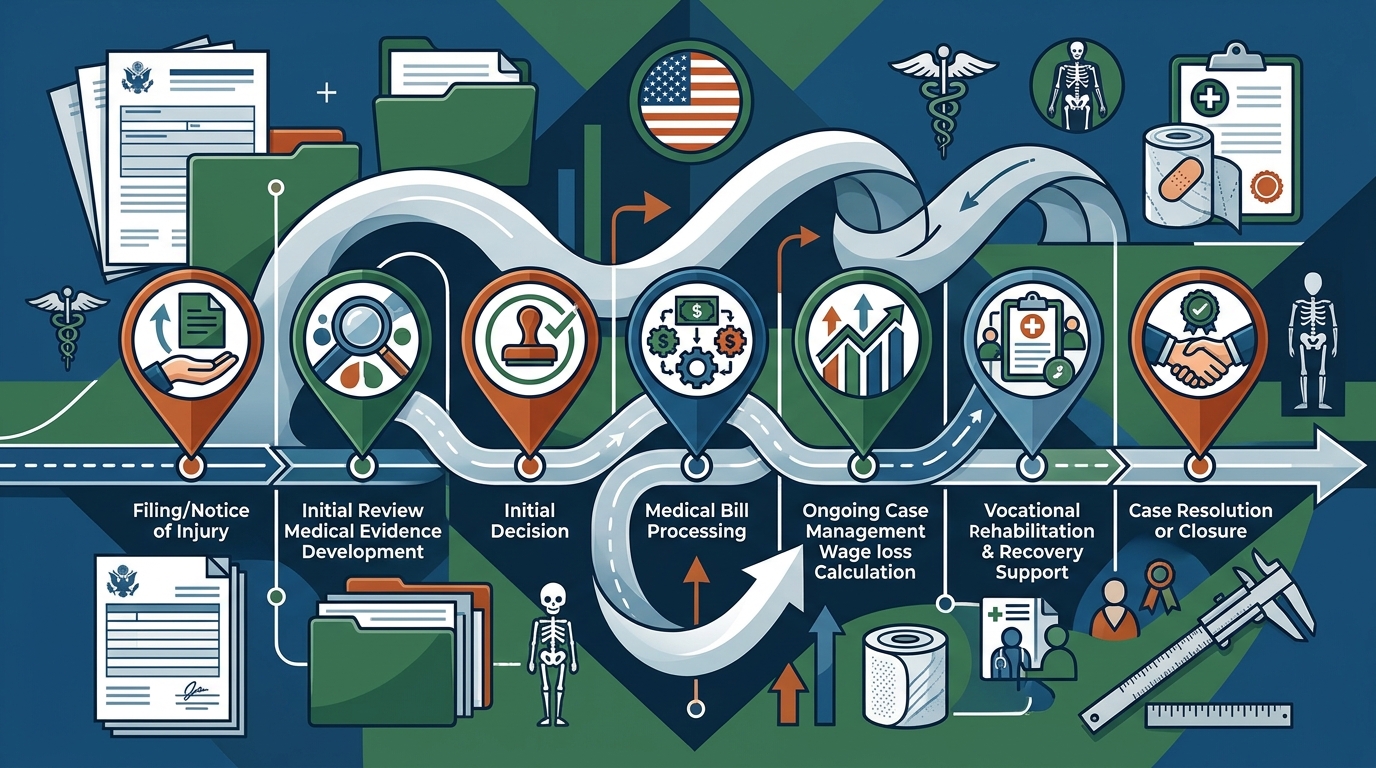
5. Benefit Calculation and Payment Setup
Accepted claims trigger the calculation of specific compensation amounts. Once a claim is accepted, the OWCP calculates the appropriate benefit rates. This includes temporary total disability, temporary partial disability, or permanent impairment benefits. The agency sets up the payment schedule and directs funds to the employee. The calculation depends on the employee's pre-injury salary and the severity of the impairment. This stage ensures the financial support is accurate and compliant with federal regulations.
6. Appeal to the Employees' Compensation Appeals Board
Employees may appeal adverse decisions to the ECAB. If the OWCP denies a claim or issues an unfavorable decision, the employee has the right to appeal. The appeal is filed with the Employees' Compensation Appeals Board (ECAB). The ECAB reviews the case record and may hold a hearing. This stage provides a crucial check on the OWCP's initial determination. It allows for a second look at the evidence and legal arguments.
7. Judicial Review and Final Resolution
Final legal recourse is available through the federal courts. If the ECAB upholds the OWCP's decision, the employee may seek review in the U.S. Court of Appeals for the Federal Circuit. This is the final stage of the administrative and judicial process. The court reviews the case for legal errors. This stage is rarely reached but provides the ultimate authority on FECA interpretations. It ensures that the administrative process adheres to federal law.
Choosing the Right Path for Your Claim
Selecting the appropriate form and gathering robust medical evidence are the most critical factors in a successful FECA claim. Federal employees should ensure their documentation is precise and that their employer is fully informed of the incident. For complex cases involving occupational diseases or disputed causation, professional guidance can help navigate the OWCP's evidence-driven requirements. Benner Law Firm provides the expertise needed to manage these federal claims effectively.
Frequently Asked Questions
What is the difference between Form CA-1 and Form CA-2?
Form CA-1 is used for traumatic injuries that occur on a specific date. Form CA-2 is used for occupational diseases that develop over a period of time. Using the wrong form can delay the processing of your claim.
How long does the OWCP take to process a claim?
Processing times vary depending on the complexity of the case and the completeness of the medical evidence. Simple traumatic injury claims may be processed faster than complex occupational disease claims. The OWCP aims to process claims within statutory timeframes, but delays can occur if additional evidence is needed.
Can I appeal an OWCP decision?
Yes, you can appeal an OWCP decision to the Employees' Compensation Appeals Board (ECAB). The appeal must be filed within a specific timeframe from the date of the decision. The ECAB will review the case record and may hold a hearing.
What happens if my claim is denied?
If your claim is denied, you will receive a letter explaining the reasons for the denial. You have the right to appeal this decision to the ECAB. You may also have the option to seek judicial review in the federal courts if the ECAB upholds the denial.
Do I need a lawyer to file a FECA claim?
You are not required to have a lawyer to file a FECA claim, but it is often recommended for complex cases. A lawyer can help ensure that your claim is properly documented and that you understand your rights. Benner Law Firm can assist with navigating the federal claims process. Learn more: Contact Benner Law Firm.