
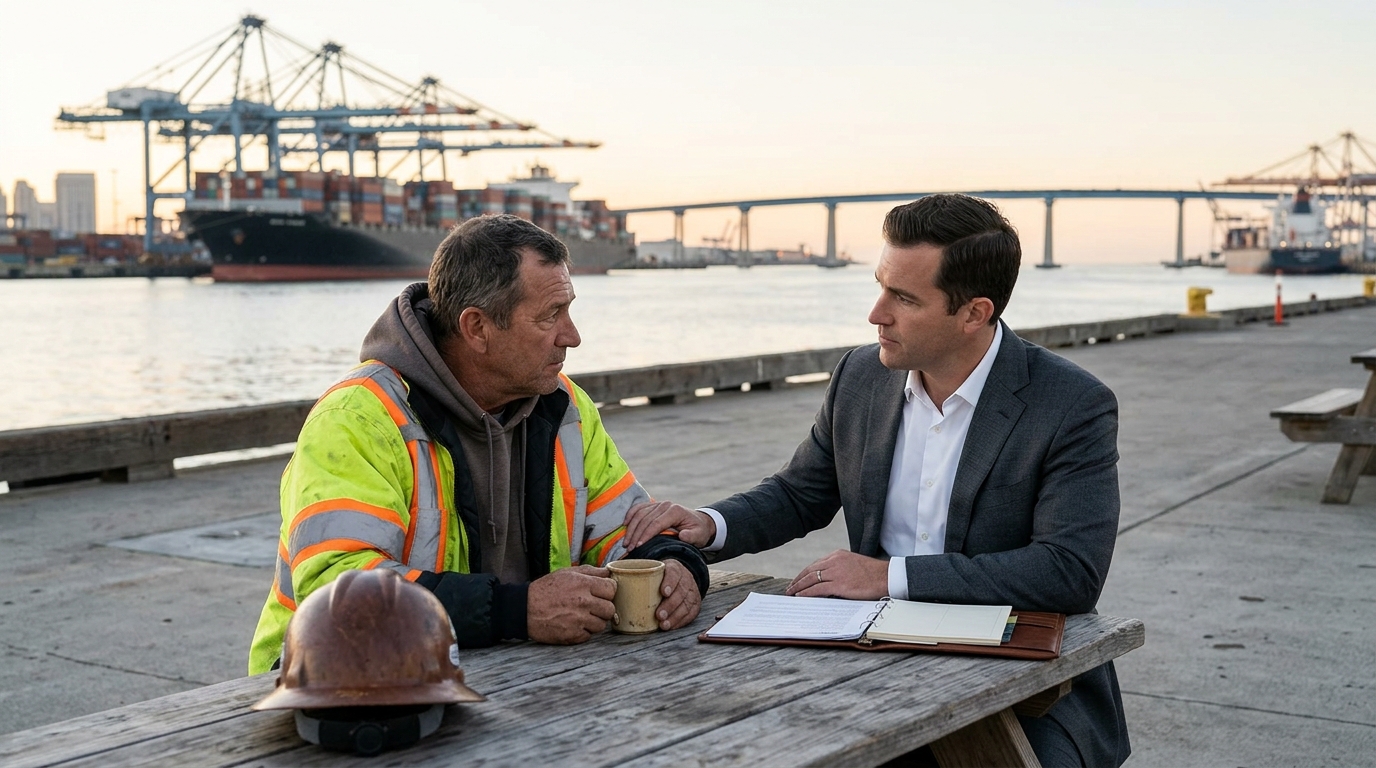
Maritime workers in San Diego face unique hazards daily, from heavy cargo operations to complex vessel maintenance. When injuries occur, the legal framework differs significantly from standard workers' compensation. The Longshore and Harbor Workers' Compensation Act (LHWCA) provides specific protections for these employees. According to the U.S. Department of Labor, the LHWCA covers approximately 15 percent of the U.S. workforce, including longshoremen, harbor construction workers, and maritime employees. Understanding your rights under this federal statute is critical for securing the medical care and wage replacement you deserve. (About Craig Benner Benner)
Understanding the Longshore and Harbor Workers' Compensation Act
The Longshore and Harbor Workers' Compensation Act is a federal law that provides wage loss and medical benefits to maritime workers who are injured on the job. Unlike state workers' compensation laws, which apply to most land-based employees, the LHWCA applies to specific maritime zones. This includes navigable waters of the United States and adjoining areas like piers, wharves, and dry docks.
The LHWCA is a no-fault system. This means you do not need to prove that your employer was negligent to receive benefits. You only need to show that your injury arose out of and in the course of your employment. However, proving the "situs" (location) and "status" (nature of work) of your employment is often the most complex part of the claim. This is where experienced legal counsel becomes indispensable.
For more information on federal maritime laws, you can visit the Department of Labor's LHWCA page.
Who Qualifies for LHWCA Coverage?
Determining eligibility under the LHWCA involves a two-part test: the status test and the situs test. The status test looks at the nature of your work. The situs test looks at where the injury occurred. Both must be met for coverage to apply.
The Status Test
To meet the status test, you must be engaged in maritime employment. This includes longshore workers, harbor construction workers, shipbuilders, ship repairers, shipbreakers, and marine construction workers. It also covers workers who are injured on the premises of a maritime workplace, even if they are not directly engaged in maritime activities at the time of the injury.
The Situs Test
The injury must occur on the navigable waters of the United States or in an adjoining area customarily used for loading, unloading, repairing, or building a vessel. In San Diego, this includes the Port of San Diego, various marinas, and industrial waterfront areas. If your injury occurred on land-based property not adjacent to navigable waters, you may be covered by California state workers' compensation instead.
For detailed eligibility criteria, refer to the U.S. Code definition of LHWCA coverage.
Why Choose Benner Law Firm for Maritime Claims
Benner Law Firm specializes in complex maritime and federal workers' compensation claims. Our firm understands the intricacies of the LHWCA and the Defense Base Act. We provide exclusive boutique firm service, delivering a results-driven practice that prioritizes attorney-client partnerships.
Our principal, Craig Benner, brings years of high-volume experience to every case. He understands that true satisfaction comes from providing benefits to clients who are eager to refer their friends and loved ones. We do not charge contingency fees for LHWCA cases. Instead, attorney fees are paid by the insurance carrier under Section 928 of the Longshore Act. This ensures that our representation is accessible to all injured workers without financial risk to you.
For more details on our fee structure, visit our Attorney Fees page.
Common Maritime Injuries and Claims
Maritime work in San Diego involves heavy machinery, hazardous materials, and unpredictable weather conditions. Common injuries include:
- Back Injuries: Often caused by lifting heavy cargo or operating machinery.
- Slip and Fall Accidents: Common on wet decks, piers, and walkways.
- Crush Injuries: Resulting from equipment malfunctions or falling objects.
- Marine Construction Injuries: Including falls from heights and drowning risks.
These injuries can lead to significant medical expenses and lost wages. Under the LHWCA, you are entitled to full medical coverage and two-thirds of your average weekly wage, subject to statutory maximums. If your injury results in permanent disability, you may be eligible for additional compensation.
Navigating the LHWCA Claims Process
Filing an LHWCA claim involves several steps. First, you must report your injury to your employer within 30 days. Failure to do so may jeopardize your claim. Next, your employer or their insurance carrier will file a report with the Office of Workers' Compensation Programs (OWCP).
If the claim is denied or benefits are delayed, you may need to file a Claim for Compensation (Form LS-20) with the local OWCP district office. This process can be complex and requires precise documentation. An experienced attorney can help you gather medical records, witness statements, and expert testimony to support your case.
For guidance on filing claims, see the Department of Labor's guide to filing LHWCA claims.
Key Takeaways for Injured Workers
- The LHWCA covers maritime workers injured on navigable waters or adjoining areas.
- You must meet both the "status" and "situs" tests to qualify for benefits.
- Benner Law Firm offers specialized representation for LHWCA and DBA claims.
- Attorney fees are paid by the insurance carrier, not the injured worker.
- Report your injury to your employer within 30 days to protect your rights.
- Benefits include medical care and two-thirds of your average weekly wage.
- Consult with a San Diego maritime attorney to navigate complex claims.
Frequently Asked Questions
What is the Longshore and Harbor Workers' Compensation Act?
The Longshore and Harbor Workers' Compensation Act is a federal law that provides wage loss and medical benefits to maritime workers who are injured on the job in navigable waters or adjoining areas.
Who is covered by the LHWCA?
The LHWCA covers longshoremen, harbor construction workers, shipbuilders, ship repairers, and other maritime employees who work on navigable waters or adjoining premises.
How do I file an LHWCA claim in San Diego?
You must report your injury to your employer within 30 days and file a Claim for Compensation (Form LS-20) with the Office of Workers' Compensation Programs if necessary.
Do I need a lawyer for an LHWCA claim?
While not required, having an experienced attorney is highly recommended due to the complexity of proving status and situs tests and negotiating with insurance carriers.
What are the attorney fees for LHWCA cases?
Attorney fees are paid by the insurance carrier under Section 928 of the Longshore Act. There are no contingency fees for the injured worker.
Can I sue my employer under the LHWCA?
Generally, no. The LHWCA is a no-fault system that provides exclusive remedies. However, you may have a third-party liability claim against other parties responsible for your injury.
What benefits are available under the LHWCA?
Benefits include full medical coverage, wage replacement at two-thirds of your average weekly wage, and compensation for permanent disability or death.
Schedule Your Free Strategy Session
If you have been injured in a maritime accident in San Diego, do not wait to seek legal help. The sooner you contact an experienced attorney, the better your chances of securing the benefits you deserve. Benner Law Firm offers free strategy sessions to discuss your case and explain your options.
Contact us today to schedule your consultation. Visit our Contact Us page or call us at 619-941-0456. We are here to champion justice with poise, precision, and passion.