

Private security specialists working overseas under U.S. government contracts face unique risks every day, from hostile environments to physically demanding duties. If you are injured on the job, you likely qualify for benefits under the Defense Base Act (DBA), a federal law that extends workers' compensation protections to civilian contractors. Filing a DBA claim correctly is critical to securing the medical care and lost wages you deserve. This guide walks you through each step of the process, explains your rights, and highlights common pitfalls so you can protect your future.
What Is the Defense Base Act?
The Defense Base Act (DBA) is a federal statute enacted in 1941 that provides workers' compensation benefits to civilian employees working outside the United States on U.S. military bases or under government contracts. It adopts the provisions of the Longshore and Harbor Workers' Compensation Act (LHWCA) with only a few exceptions. The U.S. Department of Labor administers the program through its Office of Workers' Compensation Programs (OWCP).
The DBA was originally designed to cover workers on military bases abroad, but amendments expanded it to include public works contracts, national security projects, and contracts funded through the Foreign Assistance Act. Today it is the primary mechanism through which overseas civilian contractors receive injury compensation.
Are Private Security Specialists Eligible?
Yes. Private security specialists are among the most common DBA claimants. Eligibility roles include construction, security, logistics, technical support, and administration. If you were employed by a private contractor performing work under a U.S. government contract outside the continental United States, you are almost certainly covered.
Key Eligibility Requirements
- You work for a contractor or subcontractor holding a U.S. government contract.
- Your work is performed outside the continental United States.
- Your injury occurred in the course of, or arose from, your employment.
Benefits are payable regardless of nationality, meaning U.S. citizens, host-country nationals, and third-country nationals can all file claims. Visit the private security specialist DBA page for details specific to your role.
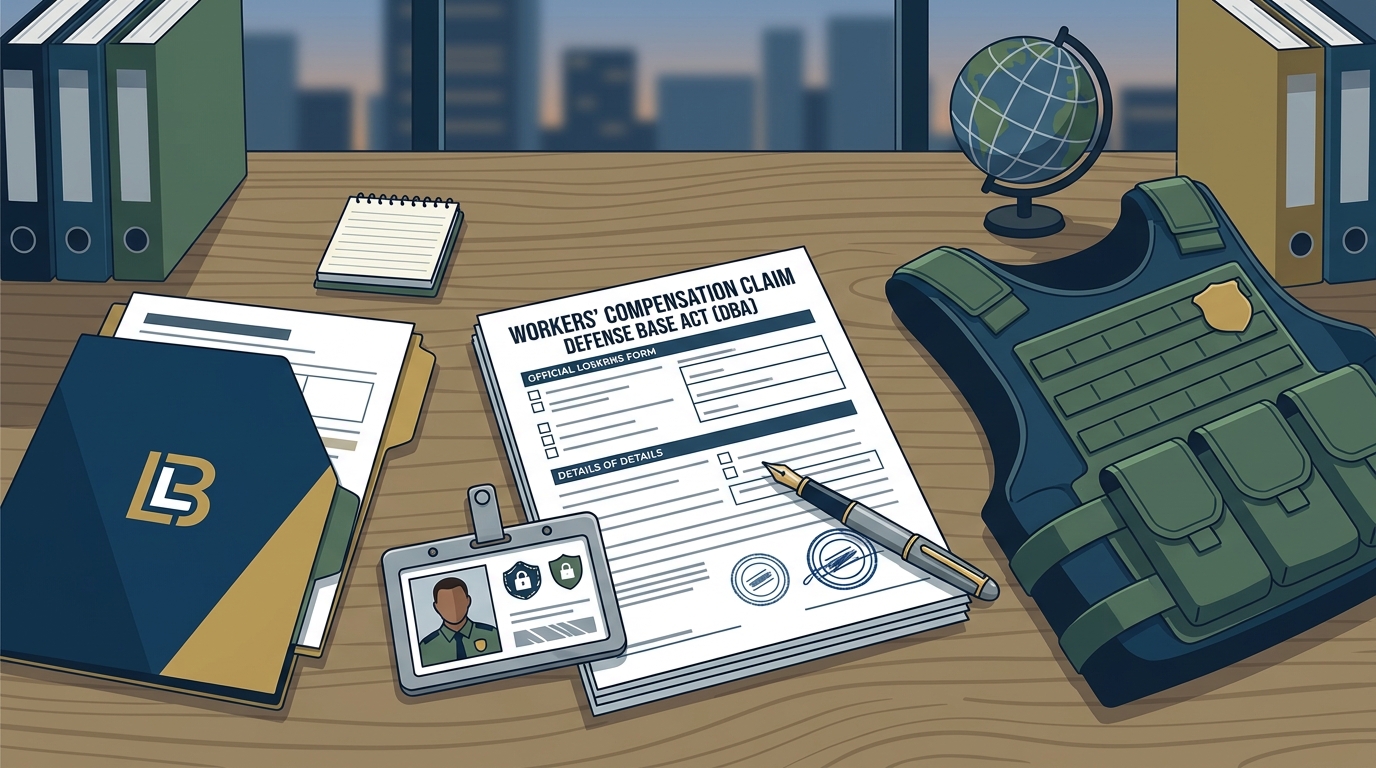
Step-by-Step: Filing Your DBA Claim
Step 1: Report the Injury Immediately
Notify your immediate supervisor as soon as possible after the injury. Prompt reporting creates a documented record and satisfies your legal obligation under the LHWCA framework. Delays can raise questions about the legitimacy of your claim.
Step 2: Gather Critical Documentation
Collect the following before you file:
- Employment contract verifying your role under a defense-related contract
- Incident report describing how and when the injury occurred
- Medical records from initial treatment and ongoing care
- Witness statements from colleagues who saw the incident
Learn more about documentation standards in our guide to medical evidence requirements for a successful DBA claim.
Step 3: File Form LS-203 With the OWCP
Submit the Employee's Claim for Compensation (Form LS-203) to the Division of Longshore and Harbor Workers' Compensation. You can upload documents electronically through the DOL Secure Electronic Access Portal (SEAPortal). The form must be filed within one year of the injury or within one year of the last payment of voluntary compensation, whichever is later.
For a complete walkthrough, see how to file DBA claims on our website.
Benefits Available Under the DBA
DBA benefits are considered superior to many state workers' compensation programs. A disability benefit is a periodic payment calculated at two-thirds of your average weekly wage, subject to annual maximum rates set by the Department of Labor. Key benefits include:
- Medical treatment: covers surgeries, hospital visits, rehabilitation, and prescriptions for as long as treatment is necessary.
- Temporary total disability: two-thirds of your average weekly wage while you cannot work.
- Permanent partial disability: compensation adjusted to the severity rating of your injury.
- Permanent total disability: ongoing payments for life in qualifying cases.
- Death benefits: surviving family members may receive up to two-thirds of the deceased worker's weekly wage.
Explore the full breakdown on our DBA benefits page.
Common Mistakes That Delay or Deny Claims
Filing a DBA claim demands precision. A single mistake can delay or jeopardize your benefits. Here are pitfalls to avoid:
- Late reporting: Failing to notify your employer within 30 days weakens your case.
- Incomplete medical evidence: Claims lacking thorough documentation of diagnosis, treatment, and prognosis are routinely disputed by insurers.
- Missing the filing deadline: You generally have one year from the date of injury to file Form LS-203.
- Accepting low initial offers: Insurance carriers often propose settlements far below fair value.
If your claim has already been denied, read about what happens when an insurer denies a DBA claim.
DBA vs. State Workers' Compensation
A state workers' compensation system is a set of laws administered at the state level that covers employees injured within that state's borders. The DBA, by contrast, is a federal program covering overseas contractors. Understanding the differences helps you pursue the correct claim.
| Feature | Defense Base Act (DBA) | State Workers' Comp |
|---|---|---|
| Governing Law | Federal (42 U.S.C. §§ 1651-1654) | State statutes (vary by state) |
| Geographic Scope | Outside the continental U.S. | Within state borders |
| Eligible Workers | Civilian contractors under U.S. gov't contracts | Most in-state employees |
| Disability Rate | Two-thirds of average weekly wage | Varies (often 60-66%) |
| Medical Coverage Duration | Until maximum recovery | Varies; some states impose caps |
| Attorney Fees | Approved by administrative law judge | Contingency or hourly |
A claims process is the formal procedure a worker follows to request compensation for a work-related injury. Under the DBA, this process is handled by the OWCP rather than a state agency.
Key Takeaways
- The Defense Base Act covers private security specialists working overseas under U.S. government contracts.
- Report injuries to your supervisor immediately and document everything.
- File Form LS-203 with the OWCP within one year of injury.
- DBA benefits include medical care, disability payments, and death benefits for survivors.
- Claims are payable regardless of nationality.
- Insurance carriers often undervalue claims; legal representation improves outcomes.
- The DBA is federal law and differs significantly from state workers' compensation systems.
Frequently Asked Questions
Who qualifies for a Defense Base Act claim as a private security specialist?
Any private security specialist employed by a U.S. government contractor or subcontractor and working outside the continental United States qualifies. This includes U.S. citizens, legal residents, and foreign nationals.
How long do I have to file a DBA claim?
You must file Form LS-203 within one year of the date of injury or within one year of the last voluntary compensation payment. Missing this deadline can result in losing your right to benefits. Read our detailed guide on DBA filing deadlines.
What benefits does the DBA provide?
The DBA provides medical treatment, temporary and permanent disability payments calculated at two-thirds of your average weekly wage, and death benefits for eligible survivors. Funeral expenses are also covered.
Can I file a DBA claim for PTSD?
Yes. PTSD claims under the DBA are valid but require strong medical evidence linking your diagnosis to specific traumatic events during your assignment. Learn more about PTSD settlements under the DBA.
Do I need a lawyer to file a DBA claim?
While not legally required, an experienced DBA attorney can help you meet deadlines, compile proper documentation, and negotiate with insurance carriers. Attorney fees are approved by an administrative law judge rather than deducted from your settlement on a contingency basis.
What happens if my employer does not have DBA insurance?
If an employer fails to secure DBA coverage, you may elect to sue the employer under general tort law. The employer loses key defenses such as contributory negligence and assumption of risk. The employer also faces criminal penalties including fines up to $10,000 and imprisonment.
Is the DBA the same as state workers' compensation?
No. The DBA is a federal program specifically for overseas government contractors. State workers' compensation covers employees injured within a particular state's borders and is governed by state law.
What if my DBA claim is denied by the insurance company?
You can request an informal conference with the OWCP district director. If the dispute is not resolved, the case may proceed to a formal hearing before an administrative law judge. Having legal representation at this stage is strongly recommended.
Get Help With Your Claim Today
Filing a DBA claim as a private security specialist does not have to be overwhelming. The attorneys at Benner Law Firm specialize in Defense Base Act and Longshore Act claims and represent injured contractors across the United States and around the world. Contact Benner Law Firm for a free consultation and take the first step toward securing the compensation you have earned.