

Private security specialists face some of the most dangerous working conditions of any civilian profession, from guarding overseas military installations to protecting government assets in active conflict zones. If you have been injured on the job, you may be entitled to significant compensation for medical expenses, lost wages, and disability benefits. However, the claims process differs depending on whether you work domestically in California or overseas under a U.S. government contract. This guide walks you through every step so you can protect your rights and maximize your recovery.
Understanding Your Coverage Options
The type of workers' compensation claim you file depends entirely on where you were working when the injury occurred. Private security specialists employed within California fall under the state workers' compensation system. Those working overseas on U.S. military bases or under government contracts are covered by a separate federal program.
Security contractors working abroad do not use state systems at all. Instead, the Defense Base Act (DBA) provides a federal workers' compensation framework specifically designed for civilian employees on overseas government contracts. Understanding which system applies to your situation is the essential first step in any claim.
| Factor | California Workers' Comp | Defense Base Act (DBA) |
|---|---|---|
| Governing Body | CA Division of Workers' Compensation | U.S. Department of Labor (OWCP) |
| Applies To | Employees injured in California | Civilian contractors injured overseas |
| Key Forms | DWC-1 Claim Form | Form LS-201 (Notice) & LS-203 (Claim) |
| Notice Deadline | 30 days | 30 days |
| Filing Deadline | 1 year | 1 year |
| Pain & Suffering | Limited | Not covered under DBA |
| Attorney Fees | Paid from recovery | Paid by insurer (fee-shifting) |
What Is the Defense Base Act?
The Defense Base Act is a federal workers' compensation law, codified at 42 U.S.C. §§ 1651-1654, that extends benefits to civilian employees injured while working outside the United States on military bases or under government contracts. It adopts most provisions of the Longshore and Harbor Workers' Compensation Act (LHWCA).
Private employers and their insurance carriers fund the benefits, not the government directly. The DBA benefits program is mandatory for all contractors and subcontractors engaged in federally funded work overseas, regardless of contract size or the employee's citizenship status.
Who Qualifies Under the DBA?
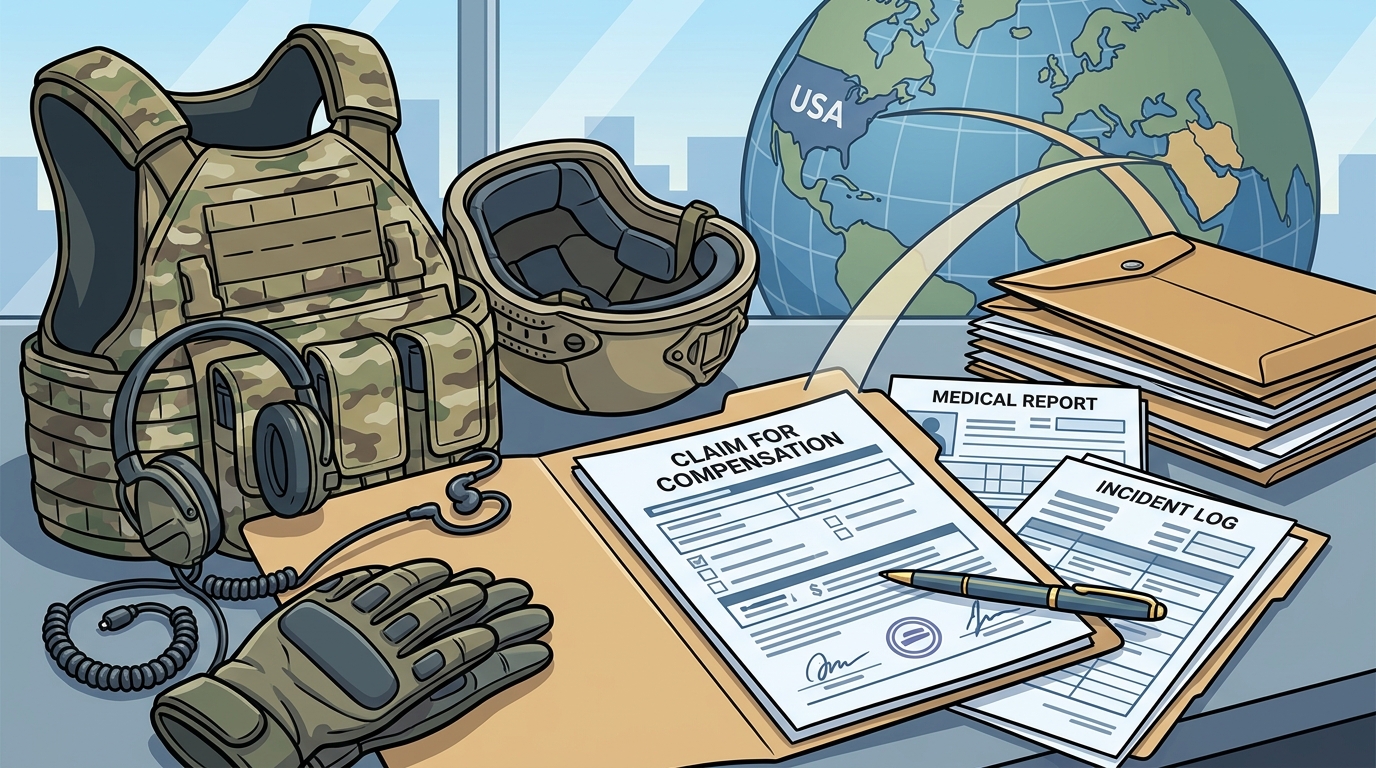
Eligible workers include security officers, linguists, truck drivers, construction workers, and virtually any civilian employee working under a U.S. government contract abroad. A private security specialist stationed at an overseas military installation is one of the most common DBA claimant profiles due to the inherent dangers of the role.
Step-by-Step: Filing Your Claim
Step 1: Seek Immediate Medical Attention
Your health comes first. Even if the injury seems minor, get evaluated by a medical professional right away. Underlying internal injuries can be masked by adrenaline and may cause permanent damage if left untreated. Document every visit, every diagnosis, and every prescription.
Step 2: Report the Injury to Your Employer
Notify your supervisor as soon as possible. For DBA claims, you must submit Form LS-201 (Notice of Employee's Injury or Death) to formally notify your employer. Keep copies of everything. Your employer will then prepare an incident report detailing what happened.
Step 3: File Your Formal Claim
Submit Form LS-203 (Employee's Claim for Compensation) to the U.S. Department of Labor, Office of Workers' Compensation Programs (OWCP). This form requires detailed information about the accident, your injuries, and your employment history. The sooner you file, the stronger your claim.
Step 4: Consult a DBA Attorney
The DBA claims process is complex and insurance carriers routinely employ tactics to minimize payouts. An experienced DBA claims attorney can manage paperwork, meet deadlines, and advocate for maximum benefits. Under the DBA's fee-shifting provision (Section 928), the insurer pays your attorney fees when benefits are successfully obtained.
Critical Deadlines You Cannot Miss
Timing is everything in a DBA claim. There are two non-negotiable deadlines you must know:
- 30-Day Notice Rule: You must give written notice of your injury to your employer within 30 days of the injury date, or from the date you became aware the injury was work-related.
- 1-Year Filing Deadline: You have one year from the date of injury (or last payment of compensation) to file Form LS-203 with the Department of Labor.
For conditions that develop gradually, such as PTSD or hearing loss, the one-year clock typically starts from the date you knew or should have known the condition was work-related. Missing these windows can permanently bar your claim, so consulting a DBA deadline attorney early is critical.
Benefits Available to Injured Security Specialists
Workers' compensation benefits under the DBA are a structured set of payments designed to cover both medical and income losses. Available benefits include:
- Medical Benefits: Full coverage for doctor visits, surgeries, hospital stays, prescriptions, physical therapy, and rehabilitation.
- Lost Wage Compensation: Typically two-thirds of your average weekly wage while you are unable to work.
- Temporary Disability: Benefits paid while you recover and cannot work, either totally or partially.
- Permanent Disability: Ongoing payments if your injury causes lasting impairment that limits your ability to work.
- Death Benefits: A percentage of the deceased's average weekly wage paid to surviving dependents, plus funeral expenses.
Psychological injuries are also covered. Conditions such as PTSD, anxiety, and depression that result from specific or cumulative trauma qualify for disability and medical benefits. Learn more about DBA PTSD settlements and how to prove a psychological injury claim.
Overcoming Insurance Company Challenges
Insurance carriers handling DBA claims are profit-driven businesses. They frequently dispute injury severity, question the credibility of medical evidence, and drag out negotiations to pressure claimants into low settlements.
Common insurer tactics include requesting unnecessary independent medical examinations, challenging whether the injury occurred within the scope of employment, and offering settlements far below what the claim is worth. Claimants who handle their cases without legal counsel often face prolonged delays, lower settlements, and higher denial rates.
Working with experienced legal representation changes the equation. An attorney familiar with DBA law can counter these strategies, present evidence effectively before an administrative law judge if your claim is denied, and pursue appeals through the Benefits Review Board when necessary.
Key Takeaways
- Private security specialists injured overseas are typically covered by the Defense Base Act, not state workers' compensation.
- You must notify your employer within 30 days and file Form LS-203 within one year of your injury.
- DBA benefits cover medical expenses, lost wages, temporary and permanent disability, and death benefits.
- Psychological injuries such as PTSD qualify for DBA compensation alongside physical injuries.
- Insurance companies routinely challenge or deny DBA claims; legal representation significantly improves outcomes.
- Under the DBA's fee-shifting provision, your attorney fees are paid by the insurer, not by you.
- Acting quickly preserves evidence and strengthens your claim.
Frequently Asked Questions
What is the Defense Base Act?
The Defense Base Act is a federal workers' compensation law that provides medical and income benefits to civilian employees injured while working outside the United States on military bases or under U.S. government contracts. It is administered by the Department of Labor's Office of Workers' Compensation Programs.
Does the DBA cover private security contractors?
Yes. Security officers are among the most common DBA claimants. Any civilian employee working under a U.S. government contract overseas is eligible for DBA benefits, regardless of nationality or specific job title.
How long do I have to file a DBA claim?
You must provide written notice to your employer within 30 days of the injury and file your formal claim (Form LS-203) with the Department of Labor within one year. For gradually developing conditions like PTSD, the clock may start when you become aware the condition is work-related.
Can I file a DBA claim after returning to the United States?
Yes. Many contractors do not realize the full extent of their injuries until after returning home. You can file a DBA claim from anywhere, as long as you are still within the legal deadlines.
Does the DBA cover PTSD and other psychological injuries?
Yes. Anxiety, depression, and post-traumatic stress disorder caused by specific incidents or cumulative trauma during overseas contract work qualify for DBA disability and medical benefits.
Do I have to pay my DBA attorney out of pocket?
No. The Defense Base Act includes a fee-shifting mechanism under Section 928 that requires the insurance carrier to pay attorney fees when benefits are successfully obtained. Ethical DBA attorneys never charge the injured worker directly.
What benefits can I receive under the DBA?
DBA benefits include full medical treatment, lost wage compensation (typically two-thirds of your average weekly wage), temporary and permanent disability payments, and death benefits for surviving dependents.
What should I do if my DBA claim is denied?
If your claim is denied, you have the right to appeal. The process involves submitting an appeal with supporting evidence to the OWCP, and you may request a hearing before an administrative law judge. An experienced DBA attorney can guide you through every stage of the appeal.
Get Help With Your Claim Today
Filing a workers' compensation claim as a private security specialist does not have to be overwhelming. The attorneys at Benner Law Firm have extensive experience representing injured contractors under the Defense Base Act and have recovered millions of dollars in benefits for their clients. Whether you were injured overseas or here in California, the legal team can evaluate your case and fight for the full compensation you deserve.
Call Benner Law Firm at 619-941-0456 to schedule a free strategy session today. Do not wait. Every day matters when deadlines are at stake.