

When you are injured due to another party's carelessness, the path to financial recovery can feel overwhelming. According to recent legal industry data, the majority of personal injury claims involve complex negotiations with insurance adjusters who often undervalue the true cost of medical care and lost wages. Understanding the specific legal mechanisms available to you is the first step toward securing the compensation you deserve. This guide outlines the critical phases of building a negligence case, from immediate evidence collection to final settlement negotiations. (About Craig Benner Benner)
Immediate Actions After an Injury
The moments following an accident define the strength of your future claim. Insurance companies often look for inconsistencies in early statements to deny liability. Therefore, your primary focus must be on safety and documentation, not on admitting fault or discussing details with the other party. (San Diego DBA amp)
Seeking Medical Attention
Even if you feel fine, adrenaline can mask serious injuries. A medical record created immediately after the incident serves as the foundational link between the accident and your injuries. Delayed treatment can be used by defense attorneys to argue that your injuries were not caused by the accident. Ensure your medical providers document the mechanism of injury clearly in your chart. (Blog Benner Law Firm)
Documenting the Scene
If physically able, collect as much visual evidence as possible. Photographs of the accident scene, vehicle damage, hazardous conditions, or visible injuries provide objective proof that contradicts later conflicting accounts. Witness contact information is equally vital, as their independent testimony can corroborate your version of events. (Disclaimer Benner Law Firm)
The Four Pillars of Negligence
To successfully seek damages, you must legally prove that the other party was negligent. Negligence is a legal concept that requires establishing four specific elements. Without all four, a claim typically fails.
Duty of Care is the legal obligation to act with reasonable caution toward others. For example, drivers have a duty to obey traffic laws, and property owners have a duty to maintain safe premises.
Breach of Duty occurs when the responsible party fails to meet that standard of care. This could be speeding, failing to clean a spill, or ignoring safety protocols.
Causation requires proving that the breach directly caused your injury. There must be a clear chain of events linking the negligent act to the harm suffered.
Damages refer to the actual losses incurred. These can be economic, such as medical bills and lost wages, or non-economic, such as pain and suffering. You cannot recover damages for a theoretical injury; you must prove tangible harm.
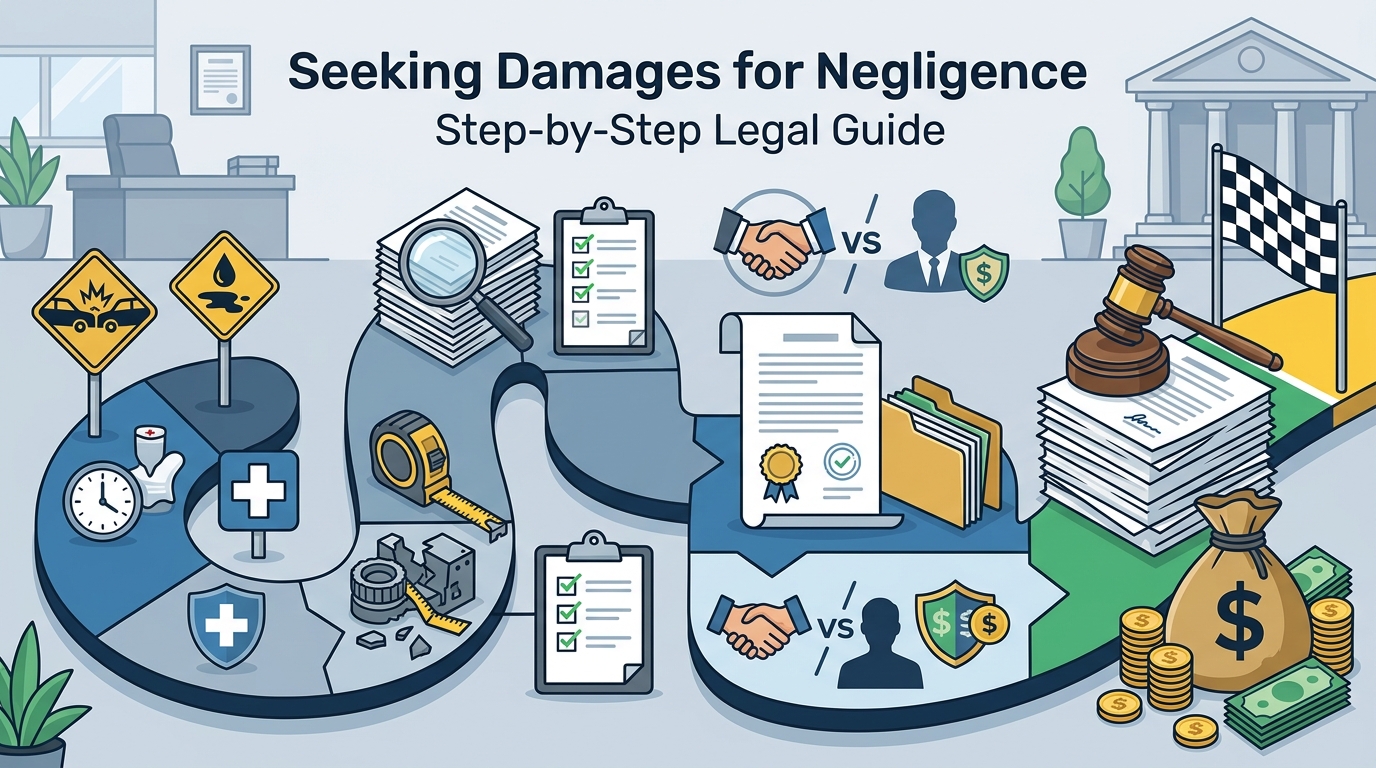
Gathering Critical Evidence
A strong negligence case relies on a robust evidentiary foundation. This phase involves compiling medical records, police reports, employment records, and expert testimonies. The goal is to create an irrefutable narrative that demonstrates the extent of your losses. (Personal injury cases)
Medical Records and Expert Testimony
Your medical records provide the timeline of your recovery. However, complex cases often require medical experts to explain the long-term impact of your injuries. These experts can testify about future medical needs, permanent disability, and the correlation between the accident and your current health status. (Personal injury cases)
Financial Documentation
Calculating economic damages requires precise financial data. This includes pay stubs to prove lost wages, tax returns to demonstrate lost earning capacity, and receipts for out-of-pocket expenses like prescription medications or home modifications.
Navigating Insurance Adjusters
Most personal injury claims are resolved through settlement negotiations rather than trial. Insurance adjusters are trained to minimize payouts. They may offer a quick, low-ball settlement to close the case before you fully understand the extent of your damages.
The Danger of Early Settlements
Accepting a settlement too early can be financially devastating. Once you sign a release, you generally cannot seek additional compensation even if your condition worsens later. Never accept a settlement offer before reaching maximum medical improvement. This is the point at which your doctor determines your condition has stabilized and any permanent effects are known.
Counter-Offer Strategy
Your attorney will calculate a demand value that includes all past and future costs. This demand is often higher than the expected settlement to allow room for negotiation. A skilled attorney will use the evidence gathered to justify this higher value, countering the insurer's attempts to devalue your claim.
When Litigation Becomes Necessary
If settlement negotiations stall or the insurance company refuses to offer a fair amount, filing a lawsuit becomes necessary. Litigation is a formal legal process that involves discovery, depositions, and potentially a trial.
The Discovery Phase
During discovery, both sides exchange information. This includes interrogatories (written questions), requests for production of documents, and depositions (sworn out-of-court testimony). This phase often reveals critical evidence that can strengthen your position or expose weaknesses in the defense's case.
Mediation and Trial
Many courts require mediation, a form of alternative dispute resolution where a neutral third party helps facilitate a settlement. If mediation fails, the case proceeds to trial. At trial, a judge or jury will decide the outcome based on the evidence presented. Having a seasoned litigator is crucial at this stage, as courtroom procedure and persuasion techniques differ significantly from negotiation tactics.
Key Takeaways
- Immediate Documentation: Gather photos, witness contacts, and medical records immediately after the incident to preserve evidence.
- Four Elements: You must prove duty, breach, causation, and damages to establish negligence.
- Maximum Medical Improvement: Wait until your condition stabilizes before accepting any settlement to ensure all future costs are accounted for.
- Insurance Tactics: Be aware that adjusters aim to minimize payouts; do not provide recorded statements without legal counsel.
- Fee Structure: Many personal injury attorneys work on a contingency basis, meaning you pay no upfront fees, and they are paid only if you recover compensation.
- Litigation Readiness: Be prepared for the possibility of a lawsuit if fair settlement offers are not made.
- Expert Support: Medical and financial experts are often necessary to quantify the full extent of your damages.
Frequently Asked Questions
How long do I have to file a negligence claim?
The statute of limitations varies by jurisdiction and the type of injury. In California, for example, the general statute of limitations for personal injury is two years from the date of the injury. Failing to file within this window can bar you from seeking compensation entirely.
What if I was partially at fault for the accident?
California follows a pure comparative negligence rule. This means you can still recover damages even if you are partially responsible for the accident. However, your compensation will be reduced by your percentage of fault. For example, if you are 20% at fault, you recover 80% of the total damages.
How are pain and suffering damages calculated?
There is no fixed formula for pain and suffering. Attorneys often use the "multiplier method," where economic damages (medical bills, lost wages) are multiplied by a factor (usually 1.5 to 5) based on the severity of the injury. Some jurisdictions also allow the "per diem" method, assigning a daily value to your suffering.
Do I need a lawyer for a minor accident?
Even for seemingly minor accidents, insurance companies may dispute liability or undervalue the claim. A lawyer ensures that all potential damages, including future medical needs, are considered. They also handle the complex paperwork and negotiations, allowing you to focus on recovery.
What is the Defense Base Act?
The Defense Base Act extends workers' compensation coverage to civilian contractors working on U.S. military bases overseas. If you are injured in such a capacity, different legal rules apply, and specialized legal counsel is essential to navigate these specific federal regulations.
How much does it cost to hire a personal injury attorney?
Most personal injury attorneys work on a contingency fee basis. This means you do not pay hourly rates or upfront costs. The attorney's fee is a percentage of the final settlement or verdict. If you do not recover compensation, you typically owe no legal fees.
Schedule Your Free Strategy Session
Navigating the complexities of negligence law requires expertise and dedication. The Benner Law Firm combines years of high-volume experience with exclusive boutique firm service to deliver results-driven representation. We prioritize attorney-client partnerships, ensuring you are treated with the compassion and precision you deserve during difficult times.
If you have been injured due to someone else's negligence, do not face the insurance companies alone. Contact us today to schedule a free strategy session. We will review the details of your case and outline a clear path forward.
Click here to contact Benner Law Firm or call us at 619-941-0456 to begin your journey toward justice.