

How to File a Workers' Compensation Claim as a Private Security Specialist
Private security specialists working overseas under U.S. government contracts face unique dangers every day, from hostile environments to physical confrontations. If you are injured on the job, standard state workers' compensation does not apply. Instead, the Defense Base Act (DBA) is the federal law that covers your right to medical care and wage-replacement benefits. Filing a DBA claim correctly and on time is critical to protecting your livelihood. This guide walks you through each step so you know exactly what to do after a workplace injury abroad.
What Is the Defense Base Act?
The Defense Base Act (DBA) is a federal workers' compensation law enacted in 1941 that extends the protections of the Longshore and Harbor Workers' Compensation Act (LHWCA) to civilian employees working outside the United States on U.S. military bases or under government contracts. The U.S. Department of Labor administers the program through its Office of Workers' Compensation Programs (OWCP).
Unlike state-level systems, the DBA is designed specifically for overseas government contractors. It covers medical treatment, disability payments, and death benefits for qualifying employees or their survivors.
Who Qualifies as a Private Security Specialist Under the DBA?
A private security specialist is a civilian contractor hired to provide protective services, such as personnel security details, base security, or convoy escort, typically on behalf of a U.S. government agency overseas. These roles are commonly filled by former military or law enforcement professionals employed by defense contractors like Constellis, GardaWorld, or Triple Canopy.
Covered Employment Categories
The DBA applies to four categories of private-sector workers: those on U.S. military bases abroad, those on public works projects under federal contract, those on projects funded through mutual security agreements, and those providing welfare or morale services to the armed forces. Security specialists almost always fall under the first or second category.
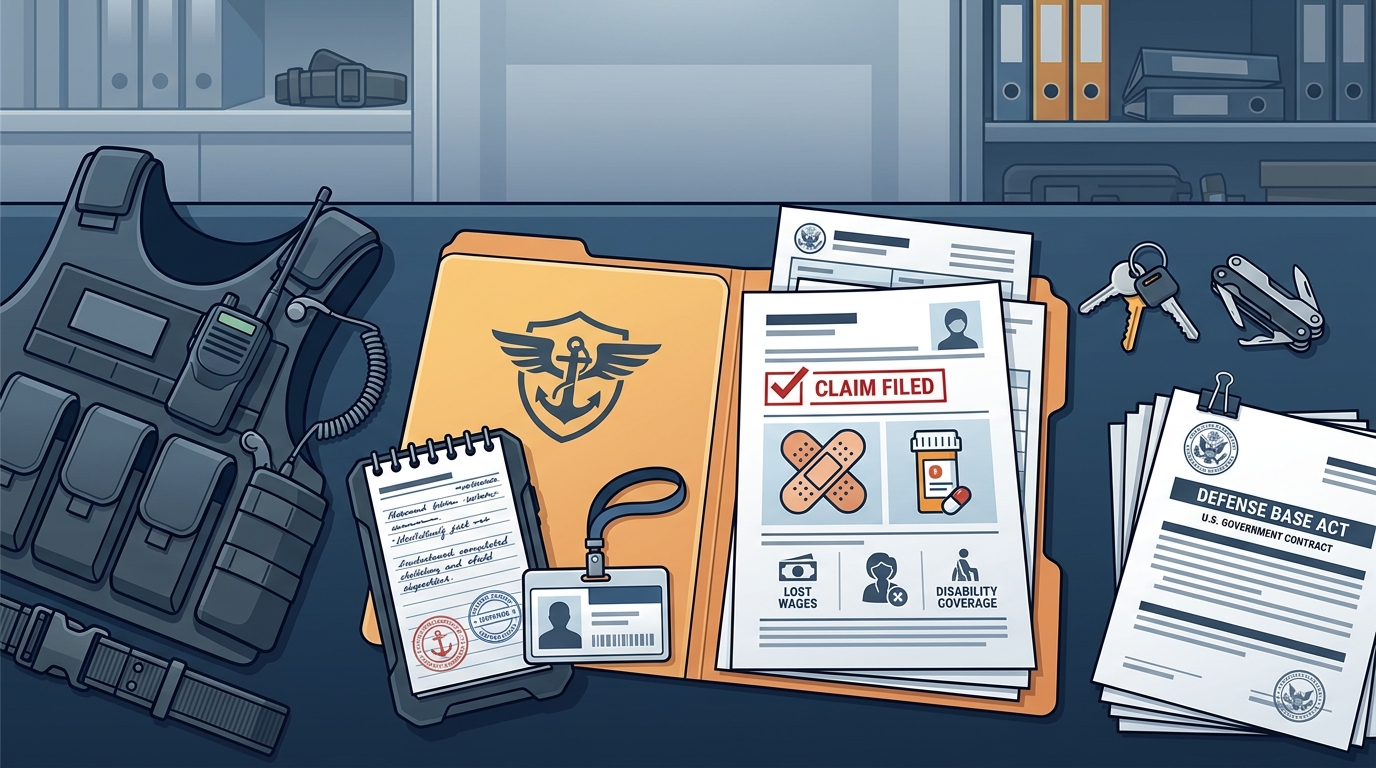
Common Injuries for Security Contractors
Injuries frequently seen in DBA security claims include gunshot wounds, blast-related traumatic brain injuries, post-traumatic stress disorder (PTSD), musculoskeletal injuries, and hearing loss from prolonged weapons exposure. Even conditions like respiratory illness from burn pit exposure may qualify.
Step-by-Step: How to File Your DBA Claim
Filing a DBA claim involves several time-sensitive steps. Missing a deadline can permanently forfeit your right to benefits. Here is what to do.
Step 1: Report the Injury to Your Employer
You must provide written notice of your injury to your employer within 30 days of the incident. For occupational diseases or conditions that develop gradually, such as hearing loss, this notice period may extend to one year. Document everything in writing and keep copies.
Step 2: File Form LS-203 With the Department of Labor
Next, complete and submit Form LS-203 (Employee's Claim for Compensation) to the OWCP Division of Longshore and Harbor Workers' Compensation. You can submit documents electronically through the Department of Labor's SEAPortal. Your formal claim must be filed within one year of the date you became aware of the injury.
Step 3: Gather Medical Evidence and Retain an Attorney
Strong medical documentation is the backbone of a successful DBA claim. Obtain detailed records linking your injury to your employment. An experienced DBA claims attorney can guide you through the evidence requirements, negotiate with the insurance carrier, and represent you at hearings if your claim is disputed.
Benefits Available to Injured Security Specialists
The DBA provides several categories of benefits for injured contractors. Understanding what you are entitled to helps you evaluate any settlement offers.
- Temporary Total Disability (TTD): Two-thirds of your average weekly wage while you are unable to work.
- Permanent Total Disability (PTD): Ongoing payments at two-thirds of your average weekly wage, with annual cost-of-living adjustments.
- Permanent Partial Disability (PPD): Compensation based on a disability rating schedule for specific body parts.
- Medical Benefits: Full coverage for all reasonable and necessary medical treatment related to the injury.
- Death Benefits: Survivor payments to a spouse or dependents if a contractor dies from a work-related cause.
DBA vs. State Workers' Compensation: Key Differences
Many injured security specialists initially assume they should file a state workers' comp claim. However, the DBA operates under a completely separate federal framework. The table below highlights the main differences.
| Feature | Defense Base Act (DBA) | State Workers' Compensation |
|---|---|---|
| Governing Law | Federal (42 U.S.C. § 1651) | State statutes (varies by state) |
| Administering Agency | U.S. Department of Labor (OWCP) | State workers' comp board |
| Geographic Coverage | Overseas U.S. government contract work | Domestic, within state borders |
| Disability Rate | 66.67% of average weekly wage | Varies (typically 60-70%) |
| Medical Benefits Duration | Until maximum medical improvement or full recovery | Varies; often subject to caps |
| Filing Deadline | 1 year from awareness of injury | Varies (30 days to 2 years) |
Because DBA benefits are considered superior to most state programs, it is important to file under the correct system from the start.
Common Mistakes That Can Derail Your Claim
Insurance carriers that provide DBA coverage, including major firms like AIG, ACE-USA, and CNA, are known for aggressively disputing claims. Avoid these pitfalls:
- Missing the 30-day notice window. Late notice to your employer gives the insurer grounds to deny your claim.
- Failing to file Form LS-203 within one year. This is a hard statutory deadline.
- Accepting a quick settlement. Early offers often undervalue long-term disabilities like PTSD or chronic pain.
- Not hiring a DBA attorney. The claims process involves informal conferences, mediations, and potentially formal hearings before an Administrative Law Judge. Legal representation significantly impacts outcomes.
If your claim has been denied, read about what to do when an insurance company denies a DBA claim.
Key Takeaways
- The Defense Base Act is the federal workers' compensation system that covers private security specialists injured while working overseas under U.S. government contracts.
- You must notify your employer in writing within 30 days of the injury.
- File Form LS-203 with the Department of Labor within one year of becoming aware of your injury.
- DBA benefits include two-thirds of your average weekly wage plus full medical coverage.
- DBA claims are separate from state workers' compensation and are administered by the federal OWCP.
- Insurance carriers routinely dispute DBA claims, making experienced legal representation essential.
- An attorney familiar with overseas civilian contractor claims can protect your rights and maximize your benefits.
Frequently Asked Questions
What is the Defense Base Act?
The Defense Base Act is a federal law passed in 1941 that provides workers' compensation benefits to civilian employees of U.S. government contractors working outside the United States. It adopts the benefit structure of the Longshore and Harbor Workers' Compensation Act.
Does the DBA cover private security contractors?
Yes. Security officers, protective detail operatives, and other security professionals working overseas under a U.S. government contract are covered by the DBA. This includes employees of subcontractors.
How long do I have to file a DBA claim?
You generally have one year from the date you became aware of the injury to file a formal claim with the Department of Labor. For occupational diseases, this deadline may extend to two years. Learn more about DBA filing deadlines.
What benefits can I receive under the DBA?
Benefits include temporary or permanent disability payments at two-thirds of your average weekly wage, full medical treatment coverage, and death benefits for surviving dependents.
Can I file a DBA claim if I have PTSD from overseas security work?
Yes. PTSD is one of the most common conditions claimed under the DBA by security contractors. You will need medical documentation from a qualified mental health professional linking your condition to your employment.
What happens if my employer does not have DBA insurance?
If an employer fails to secure DBA insurance, they face fines, loss of government contracts, and personal liability. You can still file a claim, and the prime contractor may be held responsible for your benefits.
Do I need a lawyer to file a DBA claim?
While not legally required, having a DBA attorney dramatically improves your chances of a favorable outcome. Insurance carriers employ experienced defense teams, and a knowledgeable attorney levels the playing field.
Where do I submit my DBA claim forms?
You can submit claim forms to the OWCP Division of Longshore and Harbor Workers' Compensation by mail or through the DOL's electronic SEAPortal at seaportal.dol.gov.
Get Help Filing Your DBA Claim Today
If you are a private security specialist who has been injured while working overseas, you do not have to navigate the DBA claims process alone. The Benner Law Firm specializes in Defense Base Act claims and represents injured civilian contractors across the United States and worldwide. Contact Benner Law Firm today for a free consultation and take the first step toward securing the compensation you deserve.